
Canadian Grain and Oilseed Update
- Tuesday Sept 19, 2006
This analysis featured in the September 19, 2006 issue of the HGCA's MI Prospects, Volume 9, Number 5
Key points
- Canadian 2006 field crop production seen 7.3% lower, at 67Mt
- Total wheat production forecast 3.2% down, at 25.9Mt
- Wheat exports forecast to exceed 16Mt
- Barley production estimated 17.6% lower, at 10.3Mt
- But sufficient malting barley supply
- Canola production projected over 17% lower, at 8Mt
After excellent conditions for crop establishment on the Canadian Prairies in spring, yield potential was lost during July, due to hot weather, resulting in generally only average yields. Market prospects for all the major crops are either favourable or improving.
Statistics Canada's July 31 first forecast for the Canadian 2006 field crop production placed output of the eight major crops at 67Mt, 7.3% below the very favourable 2005 harvest. Yields of all crops were lower with the exception of autumn sown wheat, which is of lesser importance due to its small production share.
Initial moisture conditions in the Prairie Provinces where the bulk of Canadian grain and oilseeds are grown were above average in spring and as a result crop establishment conditions were also very favourable. The exception to this is east central Saskatchewan where about 0.7M ha did not get sown as conditions were too wet. Although rainfall was above average over most of the Prairies, July temperatures were above average. As a result yield potential was lost and, with the exception of winter wheat, yields are generally forecast to be 5 to 10% below last year (durum, canola and peas yields are even lower). In an historic context, however, yields are generally above average even after allowing for the two drought years of 2001 and 2002. Only in three of the last ten-years has Canada harvested a larger crop than that forecast for 2006 (Graph 1). In addition to limiting yield potential, the hot weather in July advanced crop maturity by as much as 10 days to two weeks. This has improved the chances of a high quality crop and limited the likelihood of significant frost damage.
continue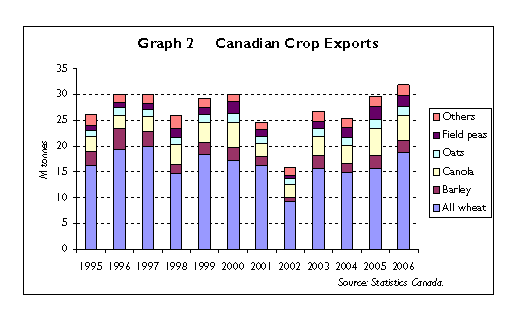 continued
Total wheat production is forecast at 25.9Mt, 3.2% less than 2006, but about 8% above the ten-year average (Table 1). The decline in output was due entirely to reduced durum area and to a lesser degree lower yields. Spring wheat production is up by 1.3% at 19.0Mt with an increase in area offsetting lower yields. More than 90% of the crop was sown to hard red springs this year.
continue continued
With US supplies of hard red winter and spring wheats reduced by drought, prospects for Canadian wheat exports are very favourable. With remaining supplies of feed wheat from the very poor quality 2004 harvest probably exhausted, domestic consumption of wheat for feeding will almost certainly be reduced and exports are seen to exceed 16Mt with little more than immediate trade requirements available at the end of the season.
The 2006 durum harvest is forecast to be 3.4Mt, 42% below 2005, reflecting lower area and weather conditions in July. Canadian durum stocks have increased in recent years even though export business has benefited from poor harvests in North Africa. With the USDA forecasting the US to be a net-importer of durum this year, the Canadian Wheat Board (CWB) is without serious competition in this market. AAFC is forecasting a reduction in carry-over stocks. The CWB recently revised its pool return outlook lowering prices for higher grades but raising them for lower grades and durum. It noted the negative impact of better than expected US spring wheat yields, offsetting the positive impact of tightening world supplies.
Barley production is forecast at 10.3Mt, 17.6% below 2005 with both area and yield reduced. The drought year of 2002 apart, this would be the smallest crop in almost 20 years. Barley suitable for malting, however, will not necessarily be in short supply as pre-harvest and harvest weather conditions generally appear to have been favourable at least in the context of germination. Although proteins will almost certainly be higher and bushel weights lower than usual, colour, germination and fusarium should not be a problem. The CWB recently raised the pool return outlook feed and designated (malting) barley for the current year by Can$5.00 (£2.40). It cited pre-US maize harvest demand for feed barley and noted improved prospects resulting from dryness in Australia and disappointing EU-25 harvest results.
Statistics Canada forecasts oats production at 3.8Mt, up 10% from 2005 with a 13% increase in area offsetting a 6% cut in yield. Early indications are that quality of the crop is good. With Scandinavian oats in short supply, the US will be more dependent than usual on Canadian oats, although transportation may limit Canada's ability to take advantage of this situation.
Canola production is projected at 8Mt, over 17% lower than last year, mainly as a result of lower yields due to the hot weather in July. Canadian canola exports, which are almost exclusively to Pacific markets, exceeded 5Mt for the first time last year. Canola oil export demand has also been rising (close to 1Mt last season) and Canadian canola crushers have for some time been working close to capacity to meet canola oil export demand.While the prospect of ballooning year-end carry-over was earlier a concern, canola supplies, now only appear adequate in terms of anticipated disposition. Canola is trading at slightly less than Can$300 (£140) /t, about 12% above values a year ago.
Flaxseed production at about 1.0Mt is about below 10% a year ago as a result of lower yields. Field pea production is estimated at 2.8Mt, down about 10% on last year. Over the last three years pea supplies have doubled but exports and domestic use have largely kept pace with this growth. Given the smaller harvest this year, supplies are likely to decline, allowing for relatively favourable market prospects. Maize production in the eastern provinces of Ontario and Quebec is placed at 9.0Mt, about 5% below last year. Production of soyabeans, also grown mainly in eastern Canada, is projected at 3.2Mt, about unchanged from a year ago. For both crops, the sown area was up, but yields were lower. Canada is a net-importer of maize but a net-exporter of soyabeans with market prospects for these two crops tied very closely to those of the US.
Although this year's crop is lower than anticipated, overall production is seen as average when compared with other years. And given an anticipated good quality crop, export prospects are seen favourable for wheat, malting barley and oats. Agriculture and Agrifood Canada (AAFC) currently forecasts that total 2006/07 exports of Canadian grains and oilseed will almost reach 32Mt, 7% higher than last year's exports (Graph 2).
continue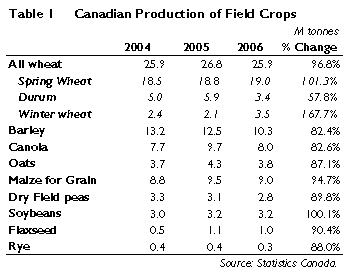 continued
David Walker 001 780 434 7615
top of page